





The Cottage in Interwar England: class and the picturesque

The Cottage in Interwar England: class and the picturesque, George Entwistle, Lund Humphries, 2024, 248 pages, 150 colour illustrations, hardback.
Do not be misled by the cover, or title, of this book. This is not yet another vapid outpouring of affection for the beauty of the English cottage. Too often, such books tell us little other than that the English have a special place in their hearts for the cottage – especially if they are thatched and timber framed – which such books simply reinforce.
No, rather this is one of the most rewarding, stimulating and enjoyable books of architectural and cultural history I have read in many years. To be precise, 44 years and the publication in 1981 of Mark Swenarton’s Homes fit for heroes: the politics and architecture of early state housing in Britain. The salutary political history of council housing he told there was later contextualised by Murray Fraser’s John Bull’s other homes: state housing and British policy in Ireland, 1833– 1922 (1993). More recently this gradual growth of serious interest in council housing has spawned popular websites such as Municipal Dreams but little, if anything, has challenged the clarity of Swenarton’s original contribution.
This important new book builds on that of its forebears by the wider cultural context it provides. As the sub-title explains, this is a book about class-relations. The central proposition is that it fell to the parliamentarians that framed the Housing Act 1919 to conceptualise houses for the working classes as ‘cottages’. What other possible conceptual models could there have been – apart from slums which so many of the ‘cottages’ of the agricultural and industrial poor already inhabited? That the interwar ‘cottage’ was an idealisation will be apparent to anyone who has read John Woodforde’s classic The Truth about Cottages (1979) or dipped a toe into the evidence presented to successive government select committee reports on housing from the mid-19th century onwards.
But Entwistle argues that this paternalistic idea of the cottage was then joined by the 18th century notion of the picturesque – the second part of the subtitle – that was able to magically transform the cottage from hovel to very heaven in the minds of those seeking housing reform. Pour in Wordsworth and the romantic movement, add a dash of the garden city movement as the final ingredient of the tradition, and the cottage could be culturally re-positioned as, to cite the title of one of Entwistle’s many sources, The House Desirable. Result? The so-called cottage estates of council houses built throughout the country during the inter-war period that form the focus of this book. These were as good as, if not better than, anything the private sector could provide and remain one of the great success stories in the history of housing. Entwistle’s meticulous research is every bit as good on accounting for the response of the private sector that resulted in the cottage becoming a symbol of private ownership while the respectable working-class had to ‘make-do’ aesthetically with the neo-Georgian ‘houses with lids on’ once housing subsidy was removed.
But why should you bother reading this book beyond furthering your understanding of why some conservation areas need the protection they do, and to recommend Article 4 Directions where appropriate? Because it is pure unalloyed joy. Beautifully written by a former senior BBC executive, fantastically illustrated (without falling prey to the chocolate box aesthetic which is rather used as part of the story), politically charged, it is rigorously argued and with intellectual insights and revelations aplenty. As if this was not enough, it is a sizeable tome at 248 pages spread over seven chapters that meticulously and methodically take apart the casting, and re-casting, of the meaning of what a cottage meant in the interwar period. And at last the publisher Lund Humphries seems to have hit its stride and is producing books with good quality printing and paper that you want to own. The only reason I found to put it down occasionally was sheer intellectual exhaustion and delight.
All I would question, but more as an interesting debate, is the extent to which the argument relies on the assumed pervasiveness of the idea of the picturesque. Can this have been so potent at the time to have marshalled the power of the cottage-myth as Entwistle argues? This was, as the author demonstrates, a revival of an 18th-century aesthetic theory, dissected and popularised in a book of 1927 by the notable Country Life author Christopher Hussey entitled The Picturesque: studies in a point of view.
You will think, dear reader, that your reviewer has lost his marbles. Admittedly I have a great interest in the topic. But reviewers are meant to make a balanced judgment so let me at least try and point out some minor negatives. I can’t. In 18th century aesthetic theory, the notion of the picturesque was countered by that of the sublime. And that’s what this book is.
This article originally appeared as ‘From hovel to heaven’ in the Institute of Historic Building Conservation’s (IHBC’s) Context 184, published in June 2025. It was written by Julian Holder, who teaches architectural history at the University of Oxford.
--Institute of Historic Building Conservation
Related articles on Designing Buildings Conservation.
IHBC NewsBlog
IHBC sponsors Gardens Trust event 23-4 Sept 2026
.jpeg)
'Learning from the Past, Shaping the Future’ takes place in Milton Keynes
Renovations to Frank Lloyd Wright's Fallingwater complete
.jpg)
World Heritage Preserved project opens house for tours again
Shakespeare Birthplace Trust places Hall's Croft on HAR Register
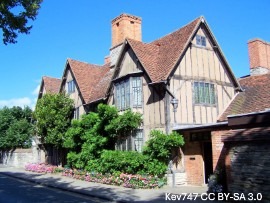
Stratford-upon-Avon home of Shakespeare's daughter is 'At Risk'
Lady Grange’s House repaired on St Kilda
.jpg)
National Trust for Scotland repairs stone cleit with link to famous island resident
Griff Rhys Jones on BBC Radio 4 Today programme
,_Green_Lane,_Derby.jpg)
The Victorian Society’s President unveiled its latest Top Ten Endangered Buildings 2026.
Need a MATE? Book your place now.

IHBC offers free webinars on applying for IHBC accreditation (Full & Associate).
UK Stained Glass Repository finds windows new homes
How are stained glass windows are rescued, stored and repurposed?
APPGEBE report sets high aims for quality
'Government must not sacrifice quality in drive to build 1.5m homes'
New measures protect Historic Shipwrecks from heritage crime

Underwater cultural heritage benefits from new HE guidance
How could the City of London skyline look in 6 years' time?

Visualisation shows approved planning applications as completed buildings
National Trust for Scotland calls for VAT cuts
Heritage neglect is encouraged by current policies
IHBC's 'Context' Issue 186 features Industrial Heritage

IHBC's members' journal reports on the challenges of conserving infrastructure
Book now for IHBC Annual School 2026

IHBC Annual School is taking place 18-20 June 2026 in Newcastle
RICHeS Research Infrastructure offers ‘Full Access Fund Call’
RICHeS offers a ‘Help’ webinar on 11 March
Latest IHBC Issue of Context features Roofing
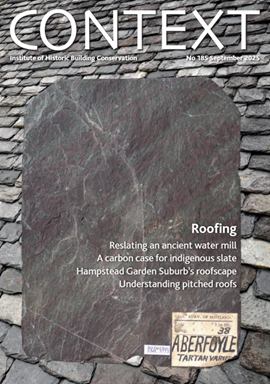
Articles range from slate to pitched roofs, and carbon impact to solar generation to roofscapes
Three reasons not to demolish Edinburgh’s Argyle House

Should 'Edinburgh's ugliest building' be saved?
IHBC’s 2025 Parliamentary Briefing...from Crafts in Crisis to Rubbish Retrofit
IHBC launches research-led ‘5 Commitments to Help Heritage Skills in Conservation’
How RDSAP 10.2 impacts EPC assessments in traditional buildings

Energy performance certificates (EPCs) tell us how energy efficient our buildings are, but the way these certificates are generated has changed.